相同組換え活性の高いCas9改変体をスクリーニングする手法の開発 by 松本さん/Development of a screening system for Cas9 variants with higher HDR activities by Daisuke Matsumoto
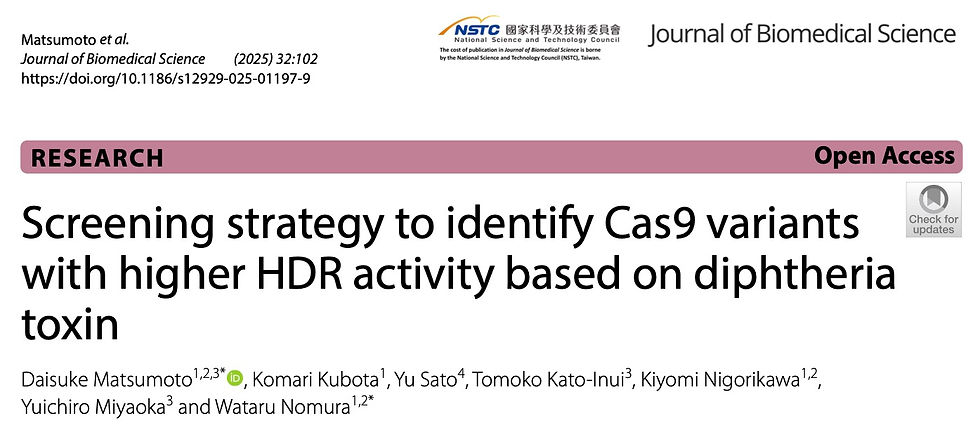
CRISPR-Cas9の登場以降、ゲノム編集による遺伝子治療の研究開発が加速し、実際に治療薬が実現するに至りました。現在のゲノム編集を用いた遺伝子治療では、疾患に関連するDNA配列を破壊することで治療を実現しています。その一方で、DNA配列破壊の仕方はランダムであり、DNA配列の破壊による副作用の可能性はゼロとは言えません。そのため、可能な限り疾患関連配列を健常者の配列に修復するような治療ができれば理想的です。そのような修復には相同組換え修復機構を利用します。そこで、本研究では相同組換え修復によって編集された細胞を選抜するシステムを応用して、切断後にHDRが起こりやすいCas9変異体のスクリーニング法を開発しました。スクリーニングによって獲得した一つの変異体において、野生型Cas9よりも高いHDR効率を示すことがわかりました。しかし、その結果には標的配列依存性がありました。今後は、より大規模なスクリーニングが可能な方法に改良していき、より多くの変異体ライブラリからの探索をすることで、相同組換え修復がより優位になるより良いCas9変異体を獲得していきたいと考えています。この研究の間で広島から東京への異動や娘の誕生など、ライフスタイルの大きな変化もありました。環境の変化に伴い、思うようにいかないこともありましたが、論文としてまとめることができてよかったです。今後も育児と両立しながら研究を進めていきたいと思います。
文責: 松本大亮
Since the emergence of CRISPR-Cas9, research and development in genome editing–based gene therapy have rapidly accelerated, ultimately leading to the realization of approved therapeutic drugs. Current genome editing therapies mainly achieve their effects by disrupting disease-related DNA sequences. However, such disruption occurs in a largely random manner, and the possibility of unintended side effects caused by DNA breakage cannot be completely eliminated. Therefore, it would be ideal if disease-associated sequences could be repaired back to their healthy form whenever possible. Such precise correction relies on the homology-directed repair (HDR) pathway. In this study, we applied a system that enriches cells repaired through HDR to develop a screening method for identifying Cas9 variants that preferentially induce HDR following DNA cleavage. Through this screening, we identified one mutant that exhibited higher HDR efficiency than wild-type Cas9. However, the enhancement showed target sequence dependency. In the future, we aim to refine the method to enable larger-scale screening and to explore more extensive mutant libraries, with the goal of identifying improved Cas9 variants that more strongly favor HDR.During the course of this research, I experienced major life changes, including relocating from Hiroshima to Tokyo and the birth of my daughter. Although these transitions sometimes made it challenging to maintain progress as planned, I am grateful that I was able to bring this work together into a manuscript. Moving forward, I hope to continue advancing my research while balancing it with childcare.
Written by: Daisuke Matsumoto


Comments